Grade Vintage Baseball Cards? Get Advice Before Selling

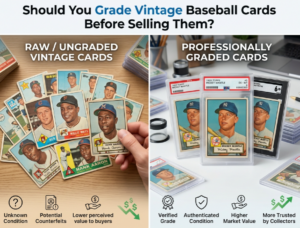
Should You Grade Vintage Baseball Cards Before Selling Them?

Grading can help some vintage baseball cards sell for more, but it can also waste money when the card, condition, timing, or buyer path does not support it. Before sending cards away, the better first move is simple: understand the as-is value, the likely grade, the grading cost, and the real selling option. At Baseball Card Adviser, we help owners make that decision before they spend money they may not get back.

Quick Answer: Grade Selectively, Not Automatically

You should not grade every card in a vintage baseball card collection before selling. Some old vintage baseball cards deserve professional grading because the grade can prove condition, support authentication, and make buyers more comfortable. Others are better sold as raw cards, especially when grading fees, time, and shipping and insurance could erode the added value.

A smarter rule is:

  • Grade stronger cards with real upside.
  • Review rare cards before making any move.
  • Avoid grading low-value cards just because they are old.
  • Check sold prices before trusting asking prices.
  • Get a pre-grading review before submitting a large collection.

That is where our baseball card consulting services help. We look at the card, the likely grade, the market, and the selling path together.

When Grading Can Help Vintage Baseball Cards Sell Better

Grading can make sense when a card has enough value, condition, or rarity to justify the process. A slabbed card gives buyers a clearer view of authenticity and condition. That can matter with rare vintage baseball cards, old rare baseball cards, pre-war issues, Hall of Famer cards, and strong-condition examples from popular sets.

Grading may help when the card is:

  • A key star, rookie, or Hall of Famer.
  • A tobacco, caramel, or early candy issue.
  • A strong card from vintage Topps baseball cards or Bowman-era sets.
  • A card with clean corners, strong centering, and good surface.
  • A card where graded baseball cards for sale show much stronger completed sale prices than raw copies.

This is why owners with antique baseball cards for sale should not guess. One card can change the whole selling plan.

When Grading Can Reduce Your Final Return

Grading is not free profit. If the grade comes back lower than expected, the extra value may not cover the cost.

Before sending cards away, ask:

  • What is the current vintage baseball cards value as raw material?
  • What grade is realistic, not hopeful?
  • What do recent sales show for that exact card and grade?
  • Will the fees, packing, shipping, and insurance reduce the final return?

Many owners ask how much old baseball cards are worth and assume grading is the answer. Sometimes it is. Sometimes the better answer is a clean review, smart sorting, and a direct sale or auction plan through our sell baseball cards support.

The Simple Math Before You Grade An Old Baseball Card

The grading decision should come down to net return, not excitement.

Use this quick check:

  • Raw card value today
  • Likely grade after review
  • Expected sale price in that grade
  • Grading fee
  • Shipping, packing, and insurance
  • Time away from your hands
  • Selling fees or auction costs
  • Final amount you expect to keep

If grading costs more than the likely added value, the card should usually stay raw.

This is especially important in old baseball card value research, because online asking prices can be misleading. Recently completed sales matter more than someone’s hopeful listing price.

Condition Details That Decide Whether Grading Makes Sense

A card does not need to look perfect, but condition decides whether grading helps, especially on old Topps baseball cards and other popular vintage sets.

Look closely at:

  • Centering: Is the image badly off-center?
  • Corners: Are they sharp, soft, rounded, or missing paper?
  • Edges: Are there chips, rough cuts, or concerns about trimming?
  • Surface wear: Are there wrinkles, stains, paper loss, or wax marks?
  • Creases: Even small wrinkles can lower the grade.
  • Writing or marks: Names, numbers, ink, and scrapbook residue matter.
  • Altered cards: Trimming, recoloring, or pressing can damage trust.

This is why grading baseball cards is not just about looking at the front. A good review studies the full card, the back, the set, the era, and the market.

Vintage Cards That Deserve A Closer Grading Review

Some cards should not be tossed into a random box of vintage cards for sale. They deserve careful review before selling.

Good candidates include:

  • Early tobacco and caramel issues.
  • Strong-condition Hall of Famer cards.
  • Key rookies from the 1950s and 1960s.
  • Better cards from Topps vintage baseball card sets.
  • Complete or partial sets with strong star cards.
  • Higher grade commons from desirable sets.
  • Scarcer regional or oddball issues.
  • Unopened vintage baseball cards or sealed material.

If your collection includes early candy issues, our Card Library can help you start identifying eras and sets. Cards like tobacco baseball cards and the American Caramel E90-1 set often need more careful review than common modern cards.

Vintage Cards You May Not Want To Grade First

Not every old card should be graded. Some are better sold raw, kept with the collection, or reviewed only if they are part of a bigger group.

Be careful with:

  • Low-value commons are in poor condition.
  • Cards with heavy creases or paper loss.
  • Later-year cards with weak demand.
  • Duplicates where only the best copy may be worth grading.
  • Large mixed boxes, where grading everything would cost too much.

This is where many sellers lose money. They see baseball cards for sale online, find the highest asking price, and assume their card will sell for a price close to that after grading. A real review looks at actual demand, exact condition, and vintage baseball card prices from real transactions.

Why A Pre-Grading Review Helps Before Selling

A pre-grading review is often the smartest step before paying for submission. Gary T. Leavitt, CFE, has reviewed and graded hundreds of thousands of cards. That experience helps owners understand what a card is likely to grade before spending on submission, packing, shipping, and insurance.

That matters most when you have:

  • An inherited collection.
  • A childhood collection found in storage.
  • A box of old baseball cards for sale from a family estate.
  • A large run of vintage baseball trading cards.
  • A collection with stars, commons, partial sets, and unknown issues.
  • A card that might need authentication before sale.

You can also learn more about Gary T. Leavitt, CFE, and our approach to careful collection advice.

Should You Grade A Whole Collection Or Only The Best Cards?

Most collections should be sorted before anything is submitted. At Baseball Card Adviser, we review large vintage card collections by era, set, player, condition, scarcity, and possible selling path. That does not mean every card should be graded. It means the full collection should be reviewed first so the strongest cards are not missed and the lower-value cards do not create unnecessary grading costs.

A better order is:

  1. Sort by era.
  2. Pull stars, rookies, and scarce issues.
  3. Review the condition.
  4. Check recent sales.
  5. Decide which cards need grading, authentication, auction, or direct sale.
  6. Keep the rest organized as part of the collection value.

For era research, 1910-1940 baseball cards, 1941-1949 baseball cards, 1950 Baseball Cards, and 1960 Baseball Cards can help owners separate broad eras before review.

Selling Options After The Grading Decision

Once the review is done, the next question is not only “Should I grade?” It is “What is the best way to sell?”

Possible paths include:

  • Sell the card raw.
  • Grade only the strongest cards.
  • Authenticate a card before sale.
  • Sell the full collection together.
  • Use an auction for high-end material.
  • Work with a private collector.
  • Accept a direct purchase option when it makes sense.

This is important for anyone asking who buys old baseball cards or checking the price of old baseball cards before making a move. The right path depends on the cards, condition, value, timing, and the work involved.

Final Checklist Before You Grade Vintage Baseball Cards

Before you send anything away, run through this:

  • Is the card valuable as-is?
  • Is the likely grade strong enough?
  • Do completed sales support grading?
  • Will costs reduce the profit?
  • Can you wait for the card to return?
  • Is there any concern about trimming or alteration?
  • Is the card part of a larger estate or set?
  • Would a private sale, auction, or direct offer be better?
  • Has an expert reviewed the card first?

If several answers are unclear, do not rush. A careful review can protect the value of the best vintage baseball cards and full collections.

Get Clear Advice Before You Spend Money Grading Cards

Grading can be a smart move, but only when it supports the sale. The goal is not to create more slabs. The goal is to protect value, avoid wasted fees, and choose the selling path that gives the collection its best chance.

We help owners understand vintage baseball card values, review old vintage baseball cards, and decide whether grading, authentication, direct sale, auction, or holding makes the most sense. If you have vintage baseball cards worth reviewing, or even related memorabilia like vintage baseballs for sale, start with a clear opinion before spending money.

For private help with a collection, contact Baseball Card Adviser and tell us what you have. We will help you decide what deserves grading, what should stay raw, and which selling option best fits the collection.