What To Know Before Selling A Collection With Hall Of Famer Cards
A collection with Hall of Famer cards can look exciting fast, but it still needs a careful review before you sell. Some cards may carry real value because of the player, set, year, rookie status, scarcity, or condition. Others may be common cards of famous players with limited resale upside. At Baseball Card Adviser, we help owners understand what they have before they accept an offer, grade the wrong cards, or break apart a collection too soon.
Do Not Sell Hall Of Famer Cards As One Random Lot
A box labeled “Hall of Famers” is not automatically a high-value collection. The real question is what type of baseball Hall of Fame cards are inside.
A smart first review should separate:
- True star cards
- Rookie cards
- Early-career cards
- High-grade vintage examples
- Complete or partial sets
- Common later-career cards
- Damaged or low-demand cards
- Raw cards and graded cards
This matters because one Mickey Mantle, Willie Mays, Hank Aaron, Jackie Robinson, Babe Ruth, Ty Cobb, Lou Gehrig, or Roberto Clemente card can deserve a different selling plan than the rest of the box. A collection should be reviewed before anything is sold, mailed, graded, or split up.
Why Player Name Alone Does Not Decide Hall Of Fame Baseball Cards Value
A famous name helps, but it does not decide everything. Hall of Fame baseball card values depend on more than the player on the front.
The main value points are:
- Year and card era
- Set and card issue
- Rookie or early-career status
- Card condition
- Scarcity
- Centering, corners, edges, and surface
- Whether the card is raw or graded
- Recent buyer demand
- Recent sold prices
A common 1970s card of a Hall of Famer may not draw the same attention as a key 1950s card, a pre-war issue, a baseball Hall of Fame rookie card checklist find, or a rare tobacco-era card. That is why it is risky to price a collection based solely on player names.
Sort The Collection Before Pulling Out The Biggest Names
When families find a vintage baseball card collection, the first instinct is often to pull out every big name. That can be helpful, but it can also create problems if those cards are part of complete sets.
Before separating anything, sort the collection by:
- Year
- Set
- Player
- Team
- Card number
- Condition
- Raw or graded status
This is especially important with a Hall of Fame set of baseball trading cards or a near-complete run of a popular vintage issue. Pulling star cards too quickly can reduce the set’s appeal. A complete or near-complete baseball Hall of Fame card set may need a different plan than a loose stack of mixed singles.
For older issues, the Card Library can help owners start recognizing eras, sets, and card types before a deeper collection review.
Condition Problems That Can Lower Hall Of Famer Card Value
Even a great player card can lose value if the condition is weak. Buyers look closely at the details, especially with Hall of Fame baseball cards from vintage sets.
Check for:
- Rounded corners
- Off-center borders
- Creases or wrinkles
- Surface wear
- Stains
- Paper loss
- Writing on the front or back
- Glue or scrapbook residue
- Trimmed edges
- Signs of alteration
A card can still be worth reviewing in a lower grade if the player, set, and scarcity are strong. But the condition determines whether it should be sold raw, graded, authenticated, auctioned, or kept with the full collection.
When Grading Hall Of Famer Cards Makes Sense Before Selling
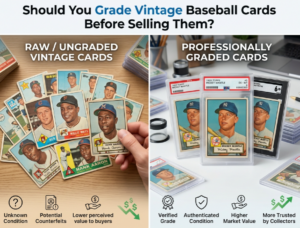
Grading can help when a card is valuable enough to justify the cost and wait. It can also help when buyers need confidence in the authentication and condition.
Grading may make sense for:
- Important baseball hall of fame rookie cards
- High-grade vintage Hall of Famer cards
- Scarce pre-war cards
- Tobacco or caramel issues
- Key cards from the 1950s and 1960s sets
- Cards with a strong recent sales history
- Cards that may fit an auction or private sale
But grading every famous player card is usually not the right move. Some cards are better reviewed first, so the owner does not incur grading fees that the final sale cannot support.
Our baseball card consulting services help owners decide which cards deserve grading, which may need authentication, and which should stay raw.
When Selling Raw Hall Of Famer Cards May Be Better
Not every Hall of Famer card needs a slab. Sometimes raw cards sell better as part of a full collection, especially when the card is common, damaged, or not valuable enough to justify professional grading.
Selling raw may be better when:
- The card has heavy wear
- The player card is common
- The grade is likely low
- The card belongs in a complete set
- The cost of grading would reduce profit
- The collection is being sold together
- The owner wants a simpler sale
This is where a careful review matters. Someone asking about the Baseball Card Hall of Fame often cares about player history, but a buyer cares about market demand, condition, scarcity, and resale path.
Complete Sets With Hall Of Famers Need Extra Care
A complete set with Hall of Famers should not be treated like a pile of singles. The set itself can carry value, especially if it features key stars, is in solid condition, and has fewer missing cards.
This is common in postwar collections, including 1950s and 1960s baseball cards. A Mickey Mantle, Hank Aaron, Willie Mays, or Roberto Clemente card may stand out, but the commons, semi-stars, and set structure still matter.
Before selling, ask:
- Is the set complete or closed?
- Are the Hall of Famers present?
- Are the key cards in similar condition?
- Are there higher-grade commons?
- Would selling singles hurt the value of the full collection?
A strong set should be reviewed as a whole before any cards are removed.
Older Hall Of Famer Cards Can Need A Different Selling Plan
Pre-war and early vintage cards deserve special attention. A group of early baseball Hall of Fame cards may include tobacco, caramel, strip, or regional issues, which are harder to identify.
For example, tobacco and caramel baseball card checklist issues can include major names and unusual variations. These cards should not be priced like ordinary modern singles.
Older cards may need:
- Set identification
- Authenticity review
- Condition review
- Scarcity check
- Grading discussion
- Private sale or auction planning
If the collection includes 1910-1940 baseball cards or 1941-1949 baseball cards, slow down before accepting a quick offer.
Inherited Collections With Hall Of Famer Cards Need A Careful Review
Many families do not know which cards matter. They may recognize Babe Ruth or Mickey Mantle, but miss a rookie card, a scarce issue, a short print, or a valuable card from a set they do not understand.
An inherited collection should be reviewed for:
- Hall of Famer names
- Rookies and early-career cards
- Complete sets
- Pre-war issues
- Autographs
- Memorabilia
- Raw and graded cards
- Condition problems
- Estate documentation needs
This is also important for law firms, estate planners, and families handling a private collection. Meet Gary T. Leavitt, CFE, to see why careful review, confidentiality, and experience matter before a collection is sold.
Choose The Right Selling Path For Hall Of Famer Cards
Once the collection is reviewed, the best-selling route becomes clearer. Some collections are a direct offer; others need grading first. Some may do better through a private sale or auction. Others should be cataloged before the owner decides.
Possible routes include:
- Direct purchase
- Private collector sale
- Auction consignment
- Grading and then sale
- Authentication first
- Full collection sale
- Selective single-card sale
Our support for selling baseball cards is built around that decision. The goal is not just to sell fast. The goal is to understand the cards, protect the value, and choose the right path.
What To Share Before Asking For A Collection Review
Before contacting an adviser, gather a few helpful details. You do not need everything to be perfect.
Helpful information includes:
- Approximate years
- Main Hall of Famer names
- Photos of fronts and backs
- Any complete sets
- Any graded cards
- Tobacco or caramel cards
- Rookie cards
- Autographs or memorabilia
- Whether it is inherited or estate-related
- Where the collection is located
This is very different from looking up a baseball Hall of Fame gift card or tickets. With cards, the value sits in the exact item, condition, scarcity, and buyer demand.
Get A Clear Review Before Selling Hall of Fame Baseball Cards
A collection with Hall of Famer cards deserves more than a quick guess. Some cards may be common. Some may be strong. A few may change the full selling plan.
At Baseball Card Adviser, we help owners review Hall of Famer cards, identify key rookie cards, understand recent sale prices, decide whether graded cards make sense, and choose between a direct sale, a private sale, an auction, authentication, or holding the collection for now.
If you have a private collection, estate group, or older box with Hall of Famer names, contact Baseball Card Adviser before selling. We can help you understand what deserves attention, what should stay together, and what selling path gives the collection the fairest chance.