
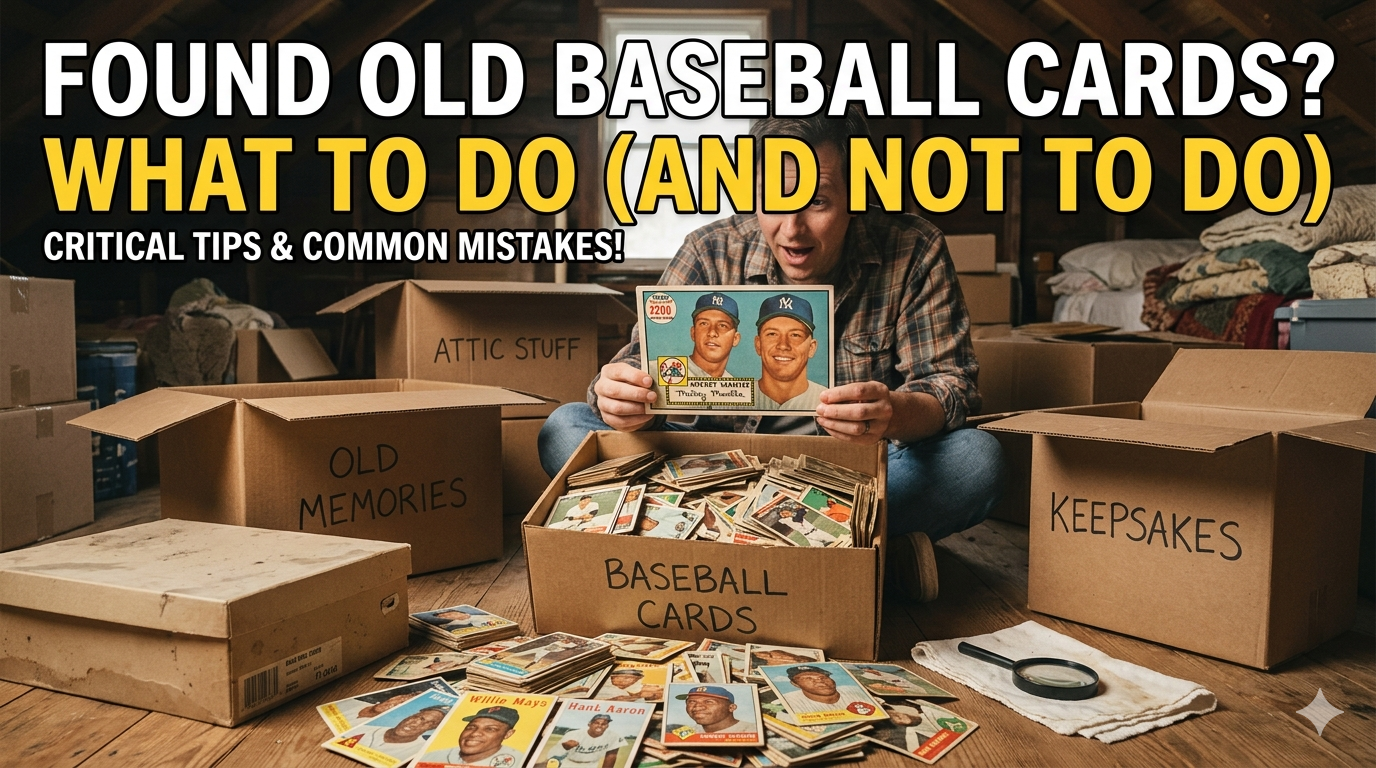
 You open a closet while clearing out your late father’s house, and there it is — a dusty shoebox, a battered binder, or a stack of rubber-banded cards held together since 1967. Your first instinct might be to toss it in the donation pile, put it on Facebook Marketplace for $20, or hand it to the first dealer who shows interest.
Stop. Just stop.
Every year, families unknowingly give away, throw away, or dramatically undersell baseball card collections worth tens of thousands of dollars — sometimes hundreds of thousands. This guide will walk you through exactly what to do when you discover a card collection while settling an estate, and more importantly, what mistakes could cost you real money.
Why This Moment Is More Important Than You Think
Baseball cards are not like other household items. A ceramic vase might be worth $40 on a good day. But a 1952 Topps Mickey Mantle in decent condition? That’s a card that has sold for hundreds of thousands of dollars. The problem is, it looks just like every other card in the box to an untrained eye.
The vintage card market has also changed dramatically over the past decade. What was considered a “common” card in the 1980s may now command serious prices on auction platforms. Collectors are actively hunting for pre-war tobacco cards, rare error prints, and low-population graded specimens. The parent whose collection you’re sorting through may have accumulated something extraordinary over 40 years of quiet collecting — and had no idea themselves.
The first and most important principle: do not act fast.
Step 1: Don’t Touch, Clean, or “Restore” Anything
This is where most people make their first and costliest mistake. Well-meaning family members try to clean dusty cards with damp cloths, press bent corners flat between books, or use rubber bands to organize them. Each of these actions can destroy value.
In the grading world, condition is everything. A card graded PSA 9 (Mint) versus PSA 5 (Excellent) can be worth 10 to 100 times more. Even microscopic surface wear matters. The dust on a card has likely been there for 60 years — it’s not going anywhere. Leave it.
Keep cards in whatever protective sleeves or holders they’re already in. If loose cards are mixed together, place them gently into a cardboard box lined with soft material. Never use tape, elastic bands, or adhesive of any kind near the cards.
Step 2: Do a Basic Visual Sort (Without Touching Card Surfaces)
Handle cards only by the edges, like a professional. Without deep knowledge, you can still do a preliminary sort that helps a consultant evaluate them faster.
Sort by era if you can identify it:
- Pre-1950 cards: Often smaller, sepia-toned, or printed on tobacco packaging. These are the ones that can be exceptionally valuable.
- 1950s–1970s cards: The classic Topps sets from this era contain some of the most sought-after cards in the hobby.
- 1980s–1990s cards: This era was over-produced. Most cards from this period, despite nostalgia, have low monetary value. Exceptions exist for rookie cards of Hall of Famers.
- Modern cards (2000s–present): Value is highly variable. Autographed or “patch” cards can be worth significant money; base cards often are not.
Set aside anything in an individual hard plastic case (called a “slab”) — these have already been professionally graded and are likely the most valuable pieces in the collection.
Step 3: Research Before You Talk to Anyone Who Wants to Buy
Before you contact a single dealer, pawn shop, or local card show vendor, do some basic research. This is not about becoming an expert overnight — it’s about knowing enough to not be taken advantage of.
Start with eBay’s “sold listings” feature. Search the name on a card, filter to “sold items,” and you’ll see what real buyers have actually paid in the last 90 days. This gives you a floor — a minimum baseline of what the market is currently bearing.
When you start researching and signing up for price guide services or collector forums, one thing to keep in mind: these platforms often come with aggressive email marketing. If you’re only researching for this one-time situation, it’s smart to use a temporary email service like nixxmail.com or disposablemails.net for these one-off signups. Your primary inbox doesn’t need to become a permanent home for auction alerts and hobby newsletters when your goal is simply to understand what you’ve inherited.
Do your research, gather baseline prices, then proceed to professional consultation with real information in hand.
Step 4: Get a Professional Appraisal — Before You Sell Anything
This is non-negotiable for any collection that appears to contain pre-1980 cards or cards in protective cases.
A professional baseball card adviser does several things a general antiques appraiser cannot:
- Authentication: Forgeries exist at every level of the hobby, from amateur reprints to sophisticated fakes that fool casual collectors.
- Grading assessment: Knowing the likely grade of an ungraded card tells you whether it’s worth submitting to PSA or Beckett (which costs money and time) or whether it’s better sold raw.
- Market timing: The card market is seasonal and player-performance-driven. A Hall of Fame induction announcement can spike a player’s card values 300% overnight. A professional knows when to hold and when to sell.
- Channel selection: Private sale, auction house, or direct-to-collector? The right channel depends on what you have.
For estates specifically, there’s an additional layer: the appraisal may be needed for IRS purposes, equitable distribution among heirs, or insurance documentation. A casual eBay search doesn’t satisfy any of those requirements.
Step 5: Consider What Happens to the Collection Long-Term
Not everyone wants to sell immediately, and that’s a valid choice. Some heirs want to keep a meaningful piece of a parent’s hobby. Others prefer to donate the collection and take a charitable tax deduction — which requires a qualified appraisal for any donation over $5,000.
If you find yourself genuinely interested in continuing the hobby — or even just selling the collection yourself over time — you’ll eventually need some infrastructure. Sellers who build an online presence for their card business (a website, a dedicated social presence, or a marketplace storefront) often find they need to think through branding. If you’re starting a small card-selling operation, even something as simple as choosing a name matters. Tools like Nameoor, an AI business name and logo generator, can help you quickly land on something professional without spending weeks overthinking it. And before you commit, checking whether similar names already exist in the hobby space — using a tool like HowManySimilar — can save you from an awkward overlap with an established dealer down the line.
These aren’t urgent decisions on day one. But if your parent’s collection ignites a genuine interest, having a proper name and identity for your selling operation will make buyers take you more seriously.
What NOT to Do: A Quick Reference
Don’t accept the first offer. Dealers at card shows and pawn shops make their living on margin. Their first offer is rarely their best.
Don’t assume old means valuable. A 1987 Donruss card is old. It’s also nearly worthless. Age alone is not the indicator — scarcity, player significance, and condition are.
Don’t post everything publicly before you know what you have. Listing a rare card on Facebook Marketplace often attracts low offers from knowledgeable buyers who know exactly what they’re looking at.
Don’t split the collection up before an assessment. Sets have value. Breaking a complete set to sell individual cards often results in less total revenue than keeping it intact for the right buyer.
Don’t throw anything away. Even seemingly worthless cards may have condition or set completion value. Let a professional make that call.
The Right First Call
If you’ve found a baseball card collection while settling an estate, the single best investment of your time is a consultation with a qualified baseball card adviser — someone who has no financial stake in purchasing your collection and whose advice is genuinely in your interest.
With 40+ years of experience, BaseballCardAdviser.com offers exactly that: ethical, professional guidance on understanding, authenticating, and maximizing the value of what you’ve found. Whether you’re planning to sell, donate, or simply understand what you’re holding, getting the right information first will always be worth it.
Your parent collected these cards over a lifetime. The least you can do is spend a few days figuring out what they’re actually worth before you let them go.