
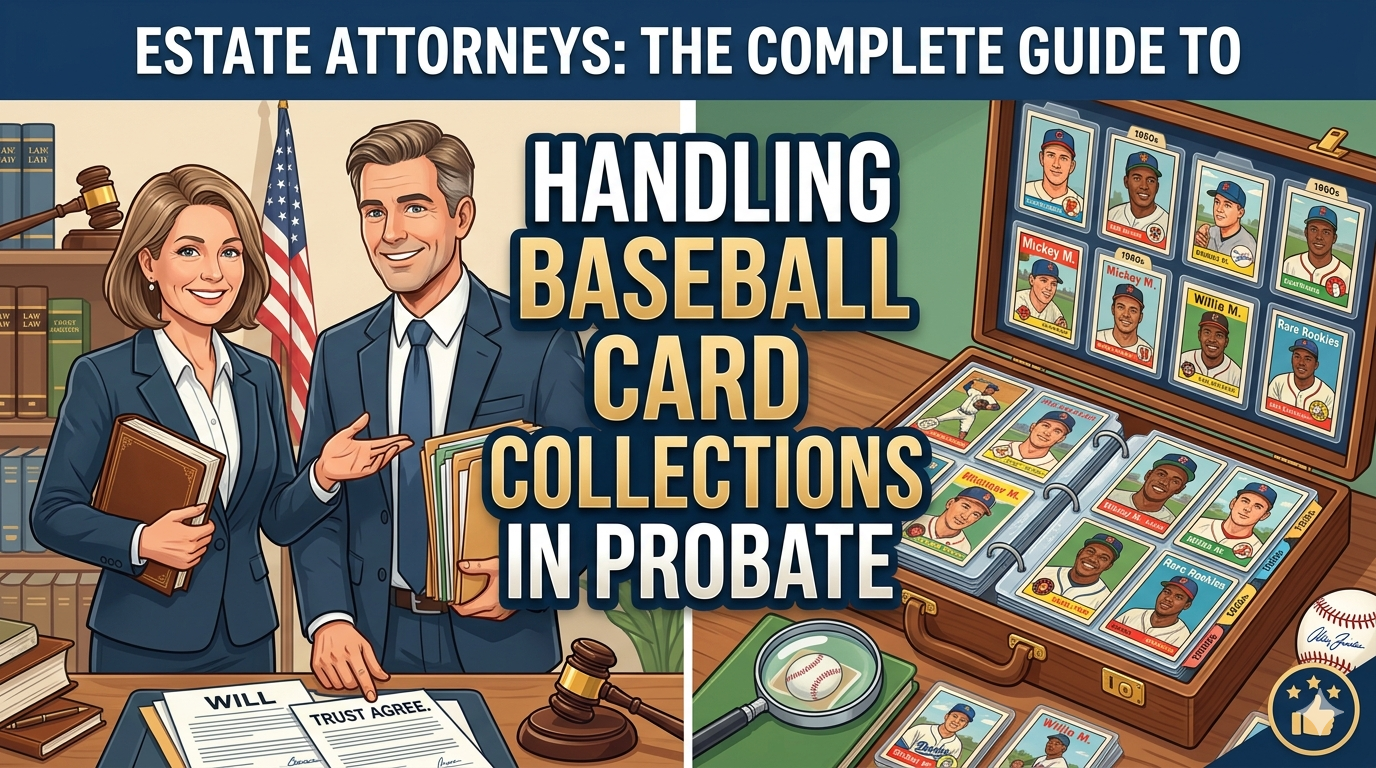
 Baseball cards don’t come up in law school. They don’t appear in standard estate planning checklists. And yet, every year, thousands of probate attorneys find themselves staring at a client’s inventory that includes “assorted sports collectibles — value unknown” and wondering what on earth to do next.
This guide is written specifically for estate attorneys, probate paralegals, and estate planning professionals who need to handle a baseball card collection correctly — not just competently, but in a way that fully protects the interests of the estate and its beneficiaries.
Because here’s what most attorneys don’t know: that “box of old baseball cards” could be worth $800. Or it could be worth $800,000. You need to know the difference before you make a single move.
Why Baseball Card Collections Are a Unique Probate Challenge
Most personal property in an estate is relatively straightforward to value. Jewelry can go to a certified gemologist. Artwork has established auction comparables. Vehicles have Blue Book values.
Baseball cards exist in a different universe entirely.
The market for vintage cards has exploded over the last decade, driven by a combination of nostalgia, COVID-era hobby growth, celebrity collector attention, and the emergence of professional grading as a standardized system. Cards that were worth $50 in 2015 regularly sell for $5,000 or more today. A single card — a 1909 Honus Wagner T206, for example — has sold for over $7 million at auction.
This extreme range of value, combined with how difficult it is to identify valuable cards without specialized knowledge, makes baseball card collections one of the most frequently mishandled estate assets in probate.
The risks are real and legally consequential:
- Undervaluation for estate tax purposes, exposing the estate to IRS scrutiny or penalties
- Inequitable distribution among heirs, particularly when one heir receives what appears to be a modest box of cards but is actually receiving significant value
- Premature or below-market liquidation, resulting in fiduciary liability for the executor
- Overlooked donation deduction opportunities, costing beneficiaries a legitimate tax benefit
Step 1: Identify and Secure the Collection
Before anything else, locate all cards. This sounds obvious, but collections are often scattered — binders in one room, shoeboxes in a closet, individual slabs (professionally graded cards in plastic cases) stored separately because the decedent knew they were valuable.
Secure the collection in a climate-controlled environment. Heat, humidity, and light are all enemies of card condition. A self-storage unit in a hot climate, for instance, is not appropriate.
Document photographically. Photograph the entire collection as found, before anything is moved, sorted, or counted. This creates a baseline record that protects the estate and the executor.
Do not allow family members — even well-meaning ones — to handle, sort, or take individual cards “just to look” before a professional assessment. This is a fiduciary matter. Cards that go missing from an estate inventory can become significant legal problems.
Step 2: Commission a Qualified Professional Appraisal
For estate purposes, “I looked it up on eBay” is not an appraisal. For any collection where fair market value may exceed $5,000 — which is more common than most attorneys expect — you need a qualified appraisal from a recognized expert in sports card collectibles.
A proper appraisal for estate purposes should include:
- Fair market value of the collection as a whole and of significant individual items
- Itemization of cards with individual values above a certain threshold
- Condition notation, which is the primary driver of value in this market
- Comparable sales data from recognized auction platforms
- Appraiser credentials and a signed statement of independence
The qualified appraisal is also required by the IRS if the estate plans to make a charitable donation of the collection and claim a deduction above $5,000. This is a planning opportunity many estates overlook — a collection with strong fair market value donated to a museum, library, or historical society can generate a meaningful deduction. Without the qualified appraisal, that deduction disappears.
Step 3: Understand the Liquidation Landscape
If the estate needs to liquidate the collection, the channel matters enormously. This is not a decision to make casually or quickly.
Option 1: Direct to Collector (Private Sale) Best for high-value individual cards or complete sets that have a targeted buyer pool. Typically yields the highest net price but requires a network and expertise to execute. A baseball card adviser with collector relationships can facilitate these transactions confidentially.
Option 2: Auction (Specialized Sports Memorabilia) Houses like Heritage Auctions, PWCC, and Goldin Auctions specialize in sports cards and reach the right buyers. Buyer’s premiums and seller’s fees apply, but a competitive bidding environment can push prices well above private sale estimates for rare material.
Option 3: Direct to Dealer The fastest option and often the lowest-yield. Dealers must buy below market to resell profitably. For a time-pressured estate, this may be acceptable — but the executor should document that other options were considered and why speed was prioritized, to protect against fiduciary claims.
Option 4: Online Platforms (eBay, MySlabs, etc.) Appropriate for lower-value cards or when the estate has time to manage individual listings. However, be aware: online platforms attract significant interest from buyers using disposable email addresses and anonymous accounts. When serious inquiries come in for high-value cards, verify that the potential buyer is using a real, traceable contact method. A flood of responses from unverifiable email addresses — a common occurrence with valuable listings — is not an indicator of genuine buyer interest. Legitimate serious buyers in this market use real identities and real contact information. Any platform that allows proper buyer verification and identity confirmation is preferable when liquidating estate assets of significant value.
Step 4: Manage Heir Expectations Carefully
Baseball card collections generate unique family dynamics during estate settlement. One heir may be a passionate fan who sees sentimental value in keeping everything. Another may want immediate cash. A third may have childhood memories of specific cards and want to claim them personally.
Your job as the estate attorney is to ensure that any distribution of the collection is based on actual fair market value, not sentiment, assumption, or whoever got to the storage unit first.
If heirs will be receiving cards as part of their distribution rather than cash equivalent, each recipient should receive documentation of what they’re receiving and its appraised value. This protects everyone and establishes a clear cost basis for future sale.
Step 5: Build a Repeatable Referral Process
If you’re handling estates with any regularity, baseball card collections will come up again. The attorneys who handle them well consistently have one thing in common: they have a trusted baseball card adviser relationship established before they need it.
This isn’t unlike having a relationship with a gemologist or a fine art appraiser. When the situation arises — and it will — you make one call and the process is professional from the start.
As a practical operational note: many law firms handling estate matters eventually create informational resources for clients, including simple web pages explaining the estate process for different asset types. If your firm is building out any kind of online presence around estate planning services — even a basic informational page for collectors or heirs — making sure that content is properly indexed by search engines matters for reach. A simple tool like MySitemaps can generate the XML or HTML sitemaps that search engines need to properly crawl and index your site’s pages. It’s a small technical step that makes a real difference for visibility.
Common Mistakes That Create Liability
Skipping the appraisal on “obviously modest” collections. Executors and attorneys who make assumptions about value without professional assessment are the ones who get calls from heirs six months later, after they’ve discovered that one of the cards that went to Goodwill sold for $12,000.
Allowing informal family distribution before inventory is complete. Once a card leaves the estate inventory informally, recovering it or establishing what it was worth becomes extremely difficult.
Using general appraisers for specialized collectibles. A certified personal property appraiser who handles furniture and jewelry is not qualified to value a baseball card collection. The market knowledge required is entirely specific to the hobby.
Accepting the first dealer offer. Dealers who approach estates directly — sometimes even appearing at the home uninvited during estate sales — are buying to resell. Their offers reflect their margin requirements, not the estate’s best interest.
Why a Baseball Card Consultant Is Different from a Dealer
This distinction is worth making explicitly: a baseball card consultant works for the collector or the estate, not for their own inventory. They have no financial incentive to purchase the collection, which means their valuation is objective and their advice is genuinely aligned with your client’s interest.
With over 40 years of experience in sports card collecting, authentication, grading, and estate consultation, BaseballCardAdviser.com is available for nationwide consultations. Whether you need a formal appraisal for estate tax purposes, a charitable donation, or simply a professional assessment before deciding how to proceed, the process starts with a conversation.
For estate attorneys handling collectibles of any kind, having the right expert in your network isn’t optional — it’s part of doing the job properly.